New Dataset: ICE 287(g) Agreements and Jurisdictions
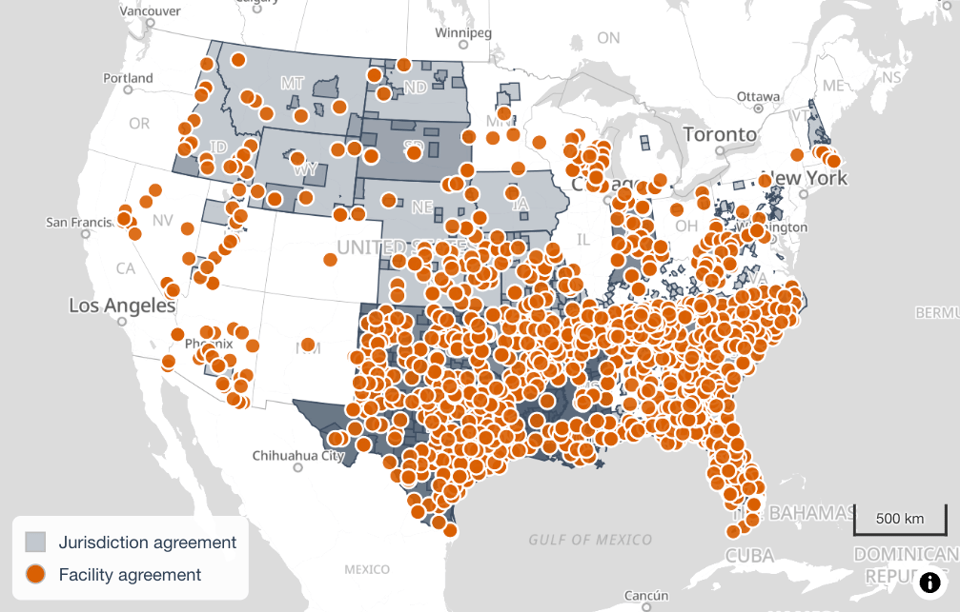
We have released a new dataset of 287(g) cooperation agreements between ICE and state or local law enforcement agencies. We also posted an interactive data explorer. (287(g) is the relevant section number in the Immigration and Nationality Act.) The dataset includes all active and historical agreements between U.S. Immigration and Customs Enforcement (ICE) and state or local law enforcement agencies since the start of the 287(g) program in 2002. This is the first such comprehensive archive. The dataset documents the locations in which each agreement applies, whether a place or a detention facility. We also link to copies of nearly all of the agreements themselves.
Our dataset builds on the important work of the Immigrant Legal Resource Center, which has tracked 287(g) agreements for many years, as well as on Andrew Thrasher’s 287(g) Program Tracker and Elijah Appelson’s Tracking 287g project.
The dataset includes information on the type of cooperation by the state/local agency (task force, jail enforcement, or warrant service officer); the dates the agreement was or is in force; and a spatial feature—either a polygon or point(s)—that corresponds to the jurisdiction or facilities covered by the agreement.
We will monitor ICE’s 287(g) web site and update the dataset when ICE posts a new participating agencies spreadsheet or new agreement documents.
The agreement-level dataset currently includes 3,153 agreements, with signing dates from July 2, 2002 to the present. Each row represents one agreement between ICE and a state or local law enforcement agency. We treat multiple agreements signed by the same agency as distinct records when they involve different types of cooperation, so an agency with separate Task Force Model (TFM), Jail Enforcement Model (JEM), and Warrant Service Officer (WSO) agreements appears once for each agreement.
As of October 16, 2026, the release includes 2,055 Task Force Model agreements, 625 Warrant Service Officer agreements, 463 Jail Enforcement Model agreements, and 10 earlier combined jail and task force agreements. The agreement-level file maps 1,168 agreements to municipal boundaries, 703 to county boundaries, 81 to state boundaries (covering 30 states), 19 to university property lines, and 30 to other kinds of jurisdictions (judicial districts, regional jurisdictions, and ports). Another 754 agreements are mapped to the locations of the detention facilities they cover. The remaining 398 agreements do not yet have mapped geographic locations, and nearly all of them are past agreements: 2,634 of the 2,688 active agreements (98%) are mapped, leaving 54 active agreements unmapped most of which are agreements with Texas constables. We are working to post these remaining boundaries.
Two notes of caution for users of the dataset:
First, the dataset represents the formal scope of 287(g) agreements as reflected in ICE’s published records. The dataset does not capture informal interactions between state or local agencies and ICE, nor does it measure the number of people arrested, detained, or transferred as a result of each agreement.
Second, although we map agreements with jails and prisons to the location of the facility, we recognize that cooperation may not end at the jail’s property line. A person may be arrested anywhere that a state or local officer has ordinary policing authority and then be booked into a participating facility.